Omega vs. Rolex in 2026: Which Holds Its Value Better?
Reviewed by Jonatan Yakubov, Certified Gemologist at DJP Jewelers & Luxury Buyers.
Updated July 2026.
Omega vs. Rolex in 2026: Which Holds Its Value Better?
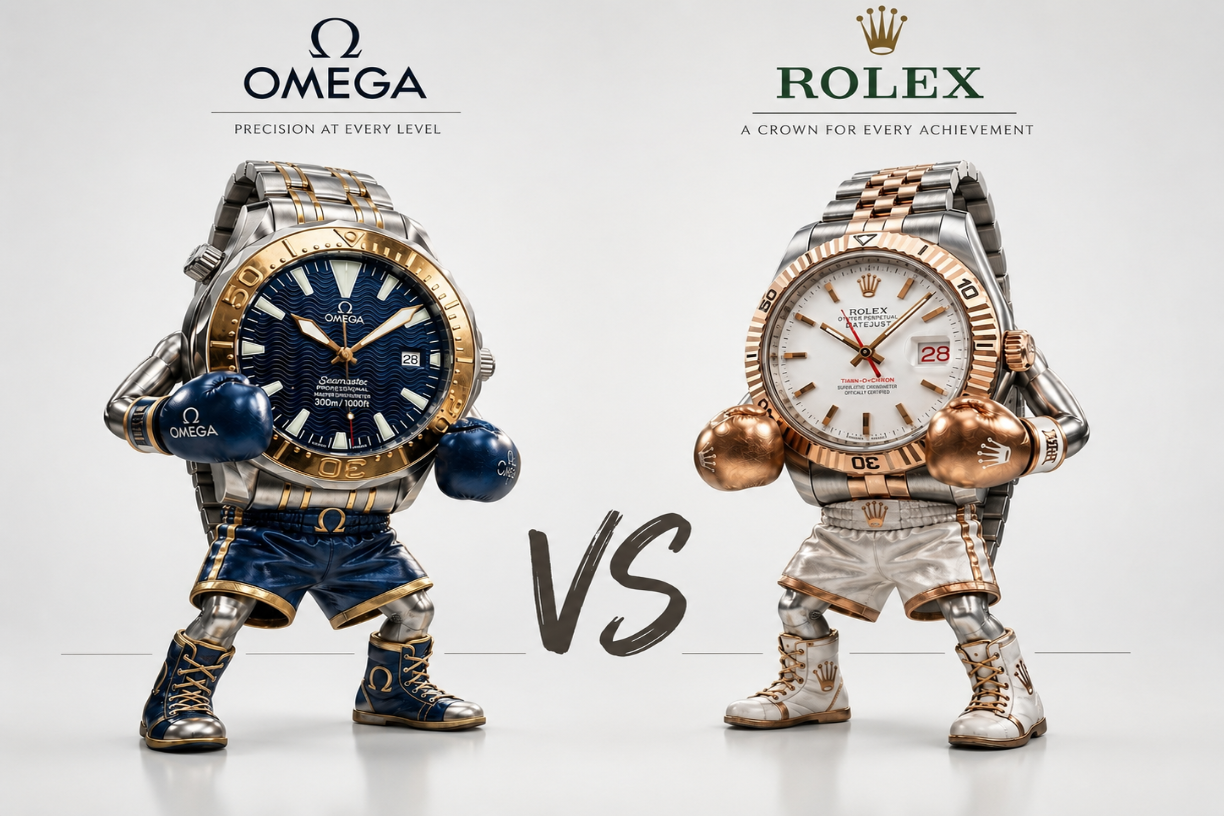
Rolex and Omega are two of the most recognizable names in Swiss watchmaking, but they behave differently on the secondary market.
Quick answer: Rolex generally holds its value better than Omega. Desirable Rolex references often benefit from stronger resale demand and limited retail availability. Omega usually depreciates more when purchased new, but it can offer excellent value when purchased pre-owned.
The final outcome still depends on the exact reference, purchase price, condition, originality, box and papers, service history, and timing of the sale. A well-bought Omega can be a better financial purchase than a Rolex acquired at an excessive secondary-market premium.
In This Guide
- Rolex vs. Omega quick comparison
- Why Rolex usually holds value better
- Why Omega can offer stronger pre-owned value
- Which models tend to perform best
- What determines resale value
- Selling a Rolex or Omega in Texas
Rolex vs. Omega: Quick Comparison
| Category | Rolex | Omega |
|---|---|---|
| Average value retention | Generally stronger | Usually lower when purchased new |
| Retail availability | Limited for certain high-demand references | Many current references are more readily available |
| Pre-owned buying value | Often requires a higher entry price | Can offer excellent value after initial depreciation |
| Collector demand | Strong across many iconic references | Strong for selected Speedmaster, Seamaster, and vintage references |
| Best fit | Buyers prioritizing resale retention and market liquidity | Buyers prioritizing history, design, technology, and purchase value |
Two Swiss Legends With Different Histories
Rolex began in London in 1905 when Hans Wilsdorf and Alfred Davis founded a watch-distribution company known as Wilsdorf and Davis. The Rolex name was registered in 1908, and the brand later became closely associated with precision, durability, and water-resistant watches.
The Rolex Oyster, introduced in 1926, became a defining part of the company’s identity. In 1927, swimmer Mercedes Gleitze wore a Rolex Oyster during a highly publicized English Channel swim, giving the brand a memorable demonstration of the watch’s water resistance.
Omega’s history dates to 1848, when Louis Brandt began assembling watches in La Chaux-de-Fonds, Switzerland. The company later adopted the Omega name after the success of its Omega caliber.
Omega became permanently connected to space exploration when the Speedmaster passed NASA’s qualification testing and was selected for crewed missions. A Speedmaster was later worn on the lunar surface during Apollo 11.
Both brands have authentic historical importance. Their different resale performance is mainly driven by demand, availability, reference desirability, retail pricing, and secondary-market liquidity.
Why Rolex Usually Holds Its Value Better
Rolex benefits from exceptional global recognition and a large secondary-market audience. Certain models also remain difficult to purchase through authorized dealers relative to demand.
This is especially relevant for recognizable sports collections such as:
- Rolex Daytona
- Rolex GMT-Master II
- Rolex Submariner
- Rolex Explorer
- Rolex Sea-Dweller
Selected configurations may trade near or above their original retail prices, although premiums change with the market and are never guaranteed.
Rolex also benefits from strong market liquidity. A desirable Rolex usually attracts a larger pool of potential buyers, which can make the watch easier to evaluate and resell.
Browse DJP’s pre-owned Rolex collection to compare available models.
Why Omega Can Offer Better Pre-Owned Value
Many current Omega references are more readily available through authorized retailers and the pre-owned market than the most in-demand Rolex sports models.
That availability means a new Omega purchased at full retail may experience a noticeable decline in resale value during the first years of ownership.
For a pre-owned buyer, that depreciation can be an advantage. The first owner may have already absorbed much of the initial decline, allowing the next buyer to acquire a respected luxury watch closer to its established secondary-market value.
Omega can therefore offer:
- Strong watchmaking and technical history
- Recognizable designs
- A lower entry price
- Less pressure to pay a secondary-market premium
- Excellent value in the pre-owned market
Browse DJP’s pre-owned Omega collection to compare current examples.
Which Rolex Models Tend to Hold Value Best?
Several Rolex sports collections receive the most attention in value-retention discussions, although performance varies significantly by reference and market cycle.
- Daytona: Particularly desirable stainless-steel and discontinued configurations
- GMT-Master and GMT-Master II: Especially recognizable bezel combinations and vintage references
- Submariner: One of the most established luxury sports-watch collections
- Sea-Dweller: Certain discontinued and collector-oriented references
- Explorer and Explorer II: Selected vintage and discontinued models
Datejust, Day-Date, Oyster Perpetual, and other Rolex collections can also retain value well, but the result depends heavily on the individual configuration and purchase price.
A desirable Rolex purchased at an inflated secondary-market premium may still produce a poor financial outcome.
Which Omega Models Tend to Hold Value Best?
Omega’s resale performance varies widely across the brand. Historically important, discontinued, limited, or highly recognizable references may perform differently from widely available current models.
- Speedmaster Professional: Particularly vintage, discontinued, limited, or historically important references
- Seamaster: Certain vintage models, special editions, and desirable professional references
- Railmaster: Selected original and limited-production pieces
- Constellation: Certain vintage pie-pan and historically significant references
- Limited editions: Performance depends on actual demand, not simply the words “limited edition”
A low production number does not automatically create collector demand. Design, history, condition, originality, and the number of interested buyers still determine the market.
What Determines the Resale Value of Either Brand?
At DJP Jewelers & Luxury Buyers, our watch specialists evaluate the complete watch rather than relying only on the brand name printed on the dial.
1. Model and Reference Number
Two watches from the same collection can have very different values. The exact reference identifies the case, movement, dial, bezel, bracelet, production period, and original configuration.
2. Condition
Ordinary wear is expected, but deep case damage, corrosion, moisture exposure, heavy impacts, and poor-quality repairs can reduce value.
Do not automatically polish a watch before evaluation. Heavy polishing can soften the original case lines and remove metal, reducing collector interest.
3. Originality
Original dials, hands, bezels, crowns, bracelets, and movement components can be especially important for vintage watches.
Service replacement parts may improve function but can change collector value. Keep any original components returned after service.
4. Box and Papers
The original box, warranty card, certificate, manuals, sales receipt, hangtags, and accessories can improve buyer confidence and marketability.
A watch can still have substantial value without papers, but a complete set is often easier to authenticate, document, and resell.
5. Bracelet and Spare Links
Missing links affect both fit and replacement cost. Bring every spare link, clasp component, strap, and buckle available with the watch.
6. Service History
Professional service records can support value by documenting maintenance and repairs. However, the cost of a service does not automatically add the same amount to the watch’s resale value.
Owners planning to keep their watch can learn more through DJP’s luxury watch repair and service page.
7. Purchase Price
The amount paid is one of the most important and frequently overlooked value-retention factors.
A pre-owned Omega purchased at a favorable price may create a better ownership outcome than a Rolex purchased at a large speculative premium. Value retention should be measured against what the owner actually paid, not only against the manufacturer’s retail price.
8. Current Market Demand
Luxury-watch prices change. A reference that traded at a large premium during one market cycle may perform differently later.
Online asking prices are not the same as completed-sale prices. Sellers may advertise watches at prices buyers are not actually paying.
What We Commonly See at DJP
Real-world evaluations are more complicated than simply saying “Rolex wins.”
- A clean, complete Omega purchased pre-owned may be a better financial buy than a Rolex acquired at an excessive premium.
- A heavily polished or poorly repaired Rolex may receive a lower offer than its owner expects.
- An original vintage Omega may be more collectible than a common modern Rolex configuration.
- A Rolex with a replacement dial, bezel, bracelet, or movement component may have a different value from a fully original example.
- A complete set can support value, but box and papers cannot compensate for serious condition or authenticity problems.
- Two visually similar watches may have very different values because of reference, production year, dial, bracelet, or movement.
Is Rolex the Better Watch?
Not automatically. Rolex generally wins the value-retention comparison, but resale value is only one reason to choose a watch.
Rolex may be a better fit for someone who prioritizes:
- Stronger average secondary-market retention
- Global recognition
- Broad buyer demand
- Ease of resale for desirable references
Omega may be a better fit for someone who prioritizes:
- Historical and technical significance
- Greater selection at a given price
- Strong pre-owned buying opportunities
- Distinctive Speedmaster and Seamaster designs
- Less pressure to pay a secondary-market premium
Is It Better to Buy an Omega New or Pre-Owned?
For buyers focused on value, purchasing Omega pre-owned can be a smart strategy because much of the initial depreciation may already be reflected in the price.
Buying new can still make sense when:
- You want the complete manufacturer retail experience.
- You value a new warranty and untouched condition.
- You receive a meaningful authorized-dealer discount.
- You plan to keep the watch for many years.
Compare Rolex, Omega, and other brands in DJP’s authenticated pre-owned luxury watch collection.
Should You Buy a Watch as an Investment?
A luxury watch should not be treated as a guaranteed financial investment. Values can rise or fall, and selling costs, servicing, condition, and market timing affect the final outcome.
The safer approach is to purchase a watch you genuinely enjoy while understanding its historical resale behavior.
Rolex generally provides stronger value retention. Omega often provides stronger purchase value. These are related ideas, but they are not the same thing.
How to Protect Your Watch’s Resale Value
- Keep the original box, papers, receipts, hangtags, and accessories.
- Save every spare bracelet link.
- Keep service invoices and replaced original components.
- Avoid unnecessary polishing.
- Use a qualified professional for repairs and servicing.
- Protect the watch from moisture, impact, and improper storage.
- Consider resale effects before modifying the dial, bezel, bracelet, or case.
- Have inherited or vintage watches evaluated before restoration.
Collectors comparing older references can also explore DJP’s vintage watch collection.
Selling a Rolex or Omega in Texas
DJP Jewelers & Luxury Buyers evaluates Rolex, Omega, and other luxury watches using reference-specific demand, authenticity, condition, originality, completeness, and service history.
Our specialists can evaluate one watch or an entire collection and provide a free, no-obligation verbal resale evaluation.
Visit our luxury watch buyers page to learn how the process works. You can also begin online through the DJP BuyBack Program before selecting the most convenient showroom.
DJP serves customers through locations in Houston near the Galleria, The Woodlands–Spring, Sugar Land, and Austin. Find the nearest showroom through our Texas locations hub.
DJP Jewelers & Luxury Buyers is a Texas luxury marketplace for buying, selling, evaluating, and servicing luxury watches, fine jewelry, diamonds, bullion, and other qualifying luxury items.
Frequently Asked Questions
Does Rolex hold its value better than Omega?
Generally, yes. Rolex typically demonstrates stronger secondary-market value retention, particularly among desirable sports references. Omega commonly experiences more depreciation when purchased new, although selected vintage, discontinued, and collector-oriented references may perform differently.
Does every Rolex increase in value?
No. Rolex values can decline, and not every reference trades above retail. Performance depends on model, configuration, condition, purchase price, completeness, and current market demand.
Is Omega a good alternative to Rolex?
Yes. Omega offers respected movements, strong space and diving history, recognizable designs, and excellent pre-owned buying opportunities. Rolex generally retains value better, while Omega may provide more watch for the purchase price.
Which Rolex models tend to hold value best?
Demand is often strongest for selected Daytona, GMT-Master II, Submariner, Sea-Dweller, and other sports references. No model is guaranteed to appreciate.
Which Omega models tend to hold value best?
Collector demand is often strongest for selected Speedmaster Professional, vintage Seamaster, discontinued, limited, and historically important references. The specific model and purchase price remain critical.
Do box and papers increase watch value?
They can improve marketability and buyer confidence, particularly for modern collectible watches. Condition, originality, authenticity, and reference desirability remain more important than packaging alone.
Should I polish my Rolex or Omega before selling it?
Not without professional advice. Aggressive polishing can remove metal and soften the original case shape, potentially reducing collector value. Have the watch evaluated before authorizing cosmetic restoration.
Can DJP evaluate a watch without its original papers?
Yes. A watch may still have significant value without its original box or papers. DJP’s specialists consider its reference, authenticity, condition, originality, components, and current market demand.
Where can I sell a Rolex or Omega in Texas?
DJP Jewelers & Luxury Buyers provides free verbal resale evaluations at locations serving Houston, The Woodlands–Spring, Sugar Land, Austin, and surrounding Texas communities. Visit our locations page or begin through the DJP BuyBack Program.
The Final Verdict
Rolex generally holds its value better than Omega. Its strongest references benefit from broad recognition, substantial collector demand, and limited retail availability relative to buyer interest.
Omega remains an excellent luxury-watch brand and may offer better value for someone purchasing pre-owned. Buyers can often obtain significant watchmaking, history, and design at a lower entry price.
- Choose Rolex when stronger average resale retention is the priority.
- Choose Omega when purchase value, history, design, and pre-owned opportunity matter more.
- Evaluate the exact reference before buying or selling either brand.
Own a Rolex, an Omega, or both? Learn how to sell your luxury watch to DJP, compare our pre-owned watch inventory, or schedule a free evaluation at one of our Texas luxury marketplace locations.

Written by Jonatan Yakubov